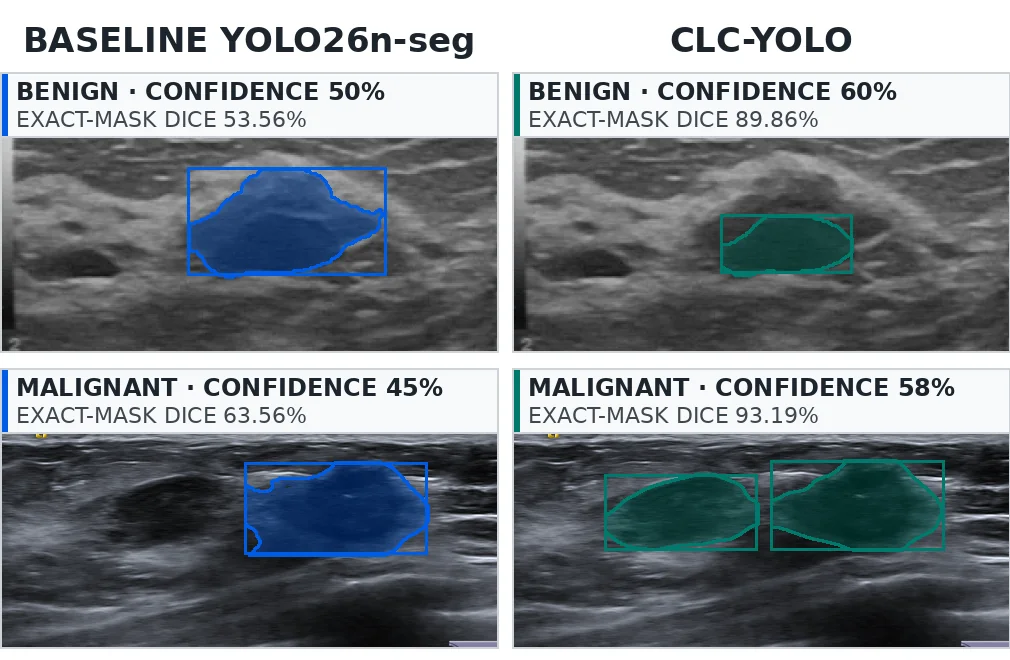
Key results
- +1.68 pp Dice on BUS-BRA, 95% CI [0.76, 2.63] pp
- 64 parameters, 0.0049 GFLOPs added
- 140 public checkpoints
- Accepted to ICAITech 2026
The question
Breast-ultrasound lesion boundaries are faint, and published results often let images of the same patient — or near-duplicate images — sit on both sides of a train/test split. CLC-YOLO asks how much a very small, targeted change to a real-time segmenter helps when the evaluation cannot leak.
Method
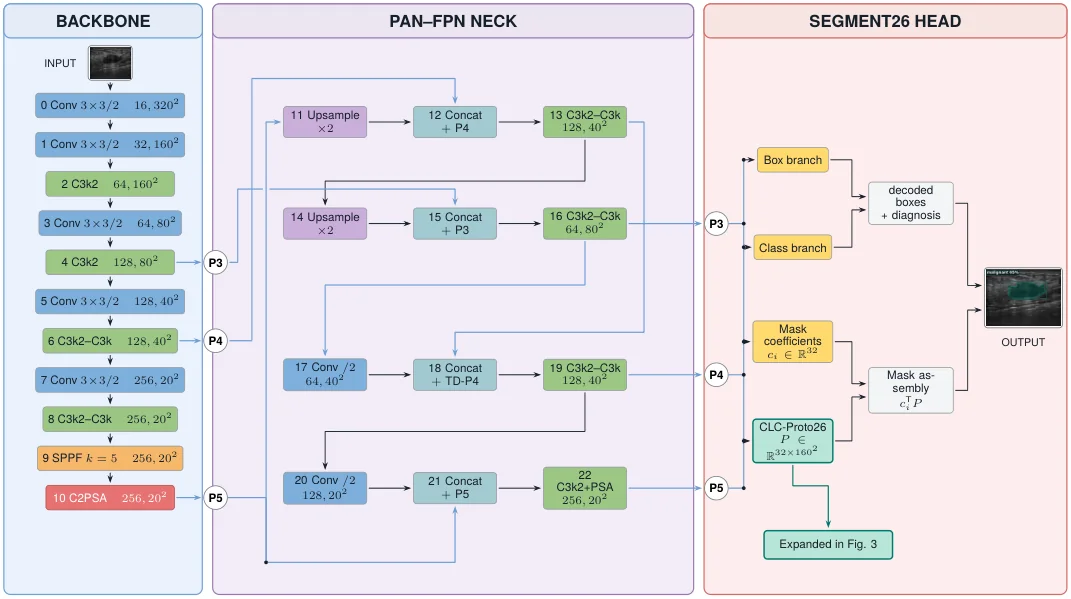
Channel Local Contrast (CLC) refines the prototype head of the YOLO26 segmentation model. It adds a fixed local high-pass residual whose strength is set by 64 zero-initialised, bounded channel gates, so at initialisation the network is exactly the baseline.
Evaluation
Baseline and CLC were compared in five matched folds on each of four datasets. BUS-BRA used patient-disjoint outer tests with separate inner validation; BUS-UCLM and BrEaST used patient-grouped folds; BUSI used duplicate-component groups because patient identifiers are unavailable.
| Dataset | Baseline Dice | CLC Dice | Gain (pp) |
|---|---|---|---|
| BUS-BRA | 87.53 | 89.21 | +1.68 |
| BUS-UCLM | 55.81 | 58.93 | +3.11 |
| BUSI | 69.56 | 70.69 | +1.12 |
| BrEaST | 67.33 | 69.78 | +2.45 |
Group-macro Dice improved on all four datasets, but only the BUS-BRA paired 95% confidence interval — [0.76, 2.63] pp — excludes zero.1Gains are computed from unrounded fold aggregates, so they can differ from the rounded table values by 0.01. The paper reports one significant result, not four.
Cost
CLC adds 64 parameters and 0.0049 GFLOPs. On a single T4 with FP16 TensorRT at 640 px, the forward pass takes 2.1478 ms against 2.0512 ms for the baseline — an overhead of 0.0966 ms.
Artefacts
The code, 140 checkpoints (7 variants × 4 datasets × 5 folds) and the COCO initialiser are public.