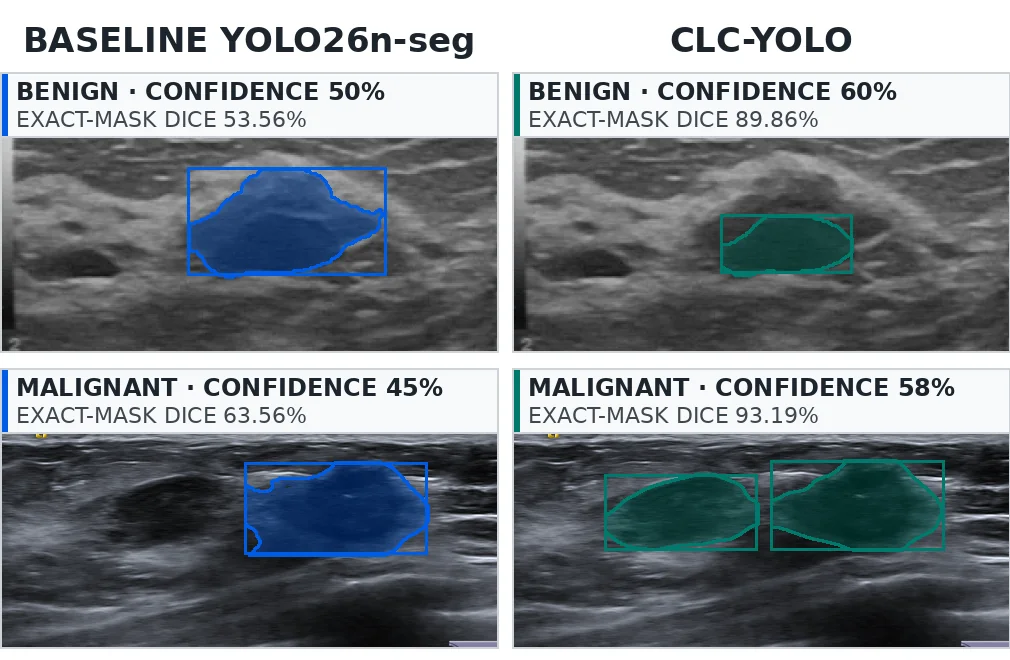
Figure 2. Channel Local Contrast for Breast Lesion Segmentation. Sixty-four learned gates on the fused YOLO26n mask-prototype feature — U′ = U + tanh(g)·(U − AvgPool₃ₓ₃(U)), with g = 0 at start — raise breast-ultrasound Dice on four datasets while the backbone, detector, mask coefficients and loss stay unchanged.
Available
Transactions on Software & Learning Systems, Vol. 2, No. 7, October 2026
M. Fazri Nizar
Software Engineer · AI/ML Research · Google SoC ’26 @ Dart
- 1 Universitas Sriwijaya — Informatics Engineering
- 2 Intelligent System Research Group (ISysRG) — DevOps & full-stack mobile engineer
Small models, honest evaluation, and the software that ships them.
Abstract
Experienced in end-to-end, cross-platform software engineering with AI/ML integration. Over the past three years I have built a body of work through international-level research [1, 2, 6], nationally registered intellectual property, and full-stack, cross-platform engineering roles at national and international companies. My skills span software engineering — full-stack, especially AI/ML and mobile — research assistance and technical leadership. I am a third-year Informatics Engineering student at Universitas Sriwijaya.
Index terms
software engineering, mobile and full-stack systems, medical image segmentation, efficient vision models, retrieval-augmented generation, applied cryptography.
Links
Introduction
- Based in
- Palembang, South Sumatra, Indonesia
- Affiliation
- Universitas Sriwijaya
- Working on
- software engineering, mobile and full-stack systems, medical image segmentation
- Status
- Open to research collaborations and remote engineering roles
I work across the stack and across the lab. At the Intelligent System Research Group I am a DevOps engineer and a full-stack mobile engineer: I keep the servers, databases and CI/CD pipelines running, and I build and maintain the group’s Flutter apps together with their Go Fiber and Python Flask services, published on Google Play and the App Store.1Including TeleOTIVA, an AI-assisted cervical-cancer screening app tested with 1,611 women at Dr. Mohammad Hoesin Hospital Palembang and twelve primary health centres.
In 2026 I was a Google Summer of Code contributor with Dart, building an experimental Android backend for package:webcrypto on the Java Cryptography Architecture.229 of my 31 pull requests to google/webcrypto.dart are merged. Mentored by Jonas Finnemann Jensen and Hamdaan Ali Quatil. Before that I spent a year as an AI software engineer at Scale AI, delivering 90+ project components across GenAI training, evaluation and feedback work for big-tech clients, and interned at Pertamina, building a knowledge-based system on retrieval-augmented generation with a small language model.
My research is in efficient computer vision for medical and underwater imaging — compact segmentation networks evaluated without patient leakage [1, 2, 4] — and in Indonesian NLP, where I presented the IDSpider text-to-SQL benchmark at IEEE ICIC 2024 [6]. I also report security issues: CVE-2026-15603 in morgan, credited by the OpenJS Foundation, and CVE-2026-96640 in Pillow, issued by GitHub.
I am a third-year Informatics Engineering student at Universitas Sriwijaya and a Beasiswa Unggulan 2024 awardee. In high school I won gold at the South Sumatra Young Scientists Competition and the 1st special award at the national competition (both 2021), then a special prize at APCYS 2022 — all in computer science, the latter two for FazScan, my website-security scanner.
News
-
CoRef-DETR is on arXiv and under review — a compact detection transformer for underwater instance segmentation [2]. more
-
Credited for CVE-2026-96640, a CPU-exhaustion flaw in how Pillow appends to existing PDFs, fixed in Pillow 13.0.0. more
-
CLC-YOLO is accepted to IEEE ICAITech 2026; code and all 140 checkpoints are public [1]. more
-
Finished Google Summer of Code 2026 with Dart: the Android JCA backend for
package:webcryptopassed the final evaluation. more -
Credited by the OpenJS Foundation for CVE-2026-15603, a log-forging flaw in the Node.js
morganlogger. more -
RF-DETR 1.9.0 ships my support for third-party training optimizers and epoch-level loss reporting. more
Experience
-
2024 now
DevOps Engineer Intelligent System Research Group (ISysRG)
Palembang, South Sumatra, Indonesia
- Maintaining the server that hosts multiple front-end, back-end and database services
- Migrating and refining the old database to the server database
- Developing the CI/CD pipeline for building and deploying front-end and back-end services
- Writing scripts for automated database and binary-file backups
- Assisting the back-end developers
Sep 2024 – Present
Palembang, South Sumatra, Indonesia
-
2024 now
Full Stack Mobile Engineer Intelligent System Research Group (ISysRG)
Palembang, South Sumatra, Indonesia
- Maintaining the Android and iOS codebases under source control
- Developing and maintaining the Flutter app, the database server (REST API, Go Fiber) and the prediction-model server (REST API, Python Flask)
- Migrating deprecated APIs according to best practices
- Hardening mobile security with industry-standard encryption
- Hardening REST-API security with a fast caching database for multi-session handling and mitigation
- Published and maintaining an app on Google Play and the Apple App Store
Jun 2024 – Present
Palembang, South Sumatra, Indonesia
-
2026
Contributor @ Google Dart Google Summer of Code
Open source · Mountain View, California, United States
Shipped an experimental Android Java Cryptography Architecture (JCA) native backend for the
webcryptopackage.- 29 of 31 pull requests merged into google/webcrypto.dart
- JCA implementations of SHA, HMAC, AES-GCM/CBC/CTR, RSA (PKCS1, OAEP, PSS), ECDSA, ECDH and HKDF
- Passed the final evaluation
May 2026 – Aug 2026
Open source · Mountain View, California, United States
-
2025 2026
AI Software Engineer Scale AI
San Francisco, California, United States
Delivered 90+ project components across 3+ projects for multiple big-tech GenAI clients, contributing to model training, evaluation and feedback cycles through layered commits, peer code reviews and QA audit feedback.
Jun 2025 – May 2026
San Francisco, California, United States
-
2024 2026
Research Assistant Artificial Intelligence Research Laboratory, Universitas Sriwijaya (AIRLab UNSRI)
Research · Indralaya, South Sumatra, Indonesia
- Assisted a senior lecturer of the Faculty of Computer Science in natural language processing research
- Built a program converting international text-to-SQL and text-emotion classification datasets to an Indonesian standard
- Developed models benchmarking the converted multilingual datasets against previous work
- One of the research-paper presenters at the Ninth International Conference on Informatics and Computing (ICIC) APTIKOM 2024
Jul 2024 – May 2026
Research · Indralaya, South Sumatra, Indonesia
-
2025 2026
Software Engineer Intern PT Pertamina (Persero)
Internship · Palembang, South Sumatra, Indonesia
Built an intelligent knowledge-based system (KBS) using retrieval-augmented generation (RAG) with a small language model (SLM) for context-aware document answers, with hallucination guardrails.
Dec 2025 – Mar 2026
Internship · Palembang, South Sumatra, Indonesia
-
2025
Laboratory Assistant, Database and Big Data Laboratory Universitas Sriwijaya
Teaching · Indralaya, South Sumatra, Indonesia
Supervised 30+ junior students during lab practicums and supported lecturers with course instruction and midterm evaluations.
May 2025 – Dec 2025
Teaching · Indralaya, South Sumatra, Indonesia
-
2025
Software Engineer DataAnnotation
New York, United States
AI-assisted code generation and review; data annotation and model training.
Apr 2025 – Jun 2025
New York, United States
-
2023 2024
Mobile Engineer Confidential
- Developed several mobile apps to client requirements
- Collaborated with back-end developers on API integration
- Integrated Firebase Cloud Messaging for push notifications
- Integrated several technology stacks as the apps’ back end
Nov 2023 – Apr 2024
Research
Papers, datasets and registered software, newest first. My name is underlined in author lists; abstract and bibtex expand in place.
Filter
-
Reference 1: , “CLC-YOLO: A Compact Channel-Gated Prototype Network for Real-Time Leakage-Aware Breast Ultrasound Lesion Segmentation,” 2nd International Conference on Artificial Intelligence and Technological Solutions (ICAITech 2026), IEEE, 2026.
Reliable breast ultrasound lesion segmentation requires accurate boundaries and evaluation that prevents patients or duplicate images from crossing data splits. We propose Channel Local Contrast (CLC), a compact refinement of the YOLO26 segmentation prototype head. CLC adds a fixed local high-pass residual controlled by 64 zero-initialized, bounded channel gates. Baseline and CLC were compared in five matched folds on each of four breast ultrasound datasets. BUS-BRA used patient-disjoint outer tests with separate inner validation. BUS-UCLM and BrEaST used patient-grouped validation folds; BUSI used duplicate-component groups because patient identifiers are unavailable. Group-macro Dice increased by 1.68, 3.11, 1.12, and 2.45 percentage points on BUS-BRA, BUS-UCLM, BUSI, and BrEaST, respectively. Only the BUS-BRA paired 95% confidence interval excluded zero. CLC adds 64 parameters and 0.0049 giga floating-point operations (GFLOPs). At 640 pixels, single-T4, batch-one, 16-bit floating-point (FP16) TensorRT graph times were 2.1478 ms for CLC and 2.0512 ms for baseline, excluding preprocessing and postprocessing. CLC increased group-macro Dice across all four datasets with a measured T4 forward-pass overhead of 0.0966 ms.
@misc{nizar2026clcyolo, author = {Nizar, M. Fazri and Rachmatullah, Muhammad Naufal and Supardi, Julian}, title = {{CLC-YOLO}: A Compact Channel-Gated Prototype Network for Real-Time Leakage-Aware Breast Ultrasound Lesion Segmentation}, year = {2026}, eprint = {2609.31702}, archivePrefix = {arXiv}, primaryClass = {cs.CV}, doi = {10.48550/arXiv.2609.31702}, note = {Accepted to the 2nd International Conference on Artificial Intelligence and Technological Solutions (ICAITech 2026)} }ICAITech 2026 · 2026
Accepted
To appear · Palembang, Nov 2026
-
Reference 2: , “CoRef-DETR: Decoupled Global Context and Selective Boundary-Category Refinement for Underwater Instance Segmentation,” arXiv preprint arXiv:2606.08002, 2026.
Underwater instance segmentation supports marine surveys, aquaculture, and underwater robotics. Haze, colour casts, and low contrast blur object boundaries, and recent benchmarks distinguish up to 158 fine-grained categories. The strongest published methods mostly have 219 to 632 million parameters. This paper proposes CoRef-DETR, a compact detection transformer that targets three error sources of a real-time detector: context, boundaries, and categories. First, a decoupled global context (DGC) detector, with the base detector’s 33.4 M parameters, applies global self-attention to a 384-pixel token grid but supervises and decodes masks in a 576-pixel frame. Second, a posterior-conditioned boundary refiner with 47.7 k parameters corrects mask logits on predicted boundaries, and a quality score on the corrected masks re-ranks the detections. Third, a crop-probe category branch on frozen DINOv2 features revises the categories of at most three masks per image, where a rule fixed on validation data chooses soft fusion or a confident-disagreement gate. On five protocols of UIIS, UIIS10K, USIS10K, and USIS16K, CoRef-DETR achieves state-of-the-art mask average precision (AP), exceeding the strongest published results by 2.3 to 5.2 points, and outperforms three reproduced recent methods on the same test images (on USIS16K, with its category branch). In half precision with TensorRT, it processes an image in a median of 34 to 40 ms, JPEG decoding included, on a T4 GPU, 1.4 to 11 times faster than these methods. Ablations attribute most of DGC’s gain to the larger frame; an error analysis locates the remaining error in crowds of small objects.
@misc{nizar2026corefdetr, author = {Nizar, M. Fazri and Supardi, Julian and Rachmatullah, Muhammad Naufal}, title = {{CoRef-DETR}: Decoupled Global Context and Selective Boundary-Category Refinement for Underwater Instance Segmentation}, year = {2026}, eprint = {2606.08002}, archivePrefix = {arXiv}, primaryClass = {cs.CV}, doi = {10.48550/arXiv.2606.08002} }arXiv 2606.08002 · 2026
Under review
Under review
-
Reference 3: , “Inter-Patient Split Fetal Head Ultrasound Segmentation Dataset in YOLO Polygon Format,” Harvard Dataverse, version 1 (CC0), 2026.
An inter-patient stratified train/val/test split (70/15/15) of 3,832 fetal head ultrasound images with YOLO-format polygon segmentation labels for three anatomical structures: Brain, Cavum Septi Pellucidi (CSP) and Lateral Ventricles (LV). The images come from the HC18 Grand Challenge (van den Heuvel et al., 2018) and the fetal head biometry annotation dataset of Alzubaidi et al. (2023). Every frame of a patient sits in exactly one partition, preventing the leakage that inflates scores when frames from one patient appear in both training and test sets; the split is seeded (seed = 42) for reproducibility.
@misc{nizar2026fetaldata, author = {Nizar, M. Fazri}, title = {{Inter-Patient Split Fetal Head Ultrasound Segmentation Dataset in YOLO Polygon Format}}, publisher = {Harvard Dataverse}, year = {2026}, version = {V1}, doi = {10.7910/DVN/FKXHLL}, url = {https://doi.org/10.7910/DVN/FKXHLL} }Harvard Dataverse · 2026
Dataset · CC0 · 3,832 images
-
Reference 4: , “Domain-Guided YOLO26 with Composite BCE-Dice-Lovász Loss for Multi-Class Fetal Head Ultrasound Segmentation,” arXiv preprint arXiv:2603.26755, 2026.
Segmenting fetal head structures from prenatal ultrasound remains a practical bottleneck in obstetric imaging. The current state-of-the-art baseline, proposed alongside the published dataset, adapts the Segment Anything Model with per-class Dice and Lovász losses but still depends on bounding-box prompts at test time. We build a prompt-free pipeline on top of YOLO26-Seg that jointly detects and segments three structures, Brain, Cavum Septi Pellucidi (CSP), and Lateral Ventricles (LV), in a single forward pass. Three modifications are central to our approach: (i) a composite BCE-Dice-Lovász segmentation loss with inverse-frequency class weighting, injected into the YOLO26 training loop via runtime monkey-patching; (ii) domain-guided copy-paste augmentation that transplants minority-class structures while respecting their anatomical location relative to the brain boundary; and (iii) inter-patient stratified splitting to prevent data leakage. On 575 held-out test images, the composite loss variant reaches a mean Dice coefficient of 0.9253, exceeding the baseline (0.9012) by 2.68 percentage points, despite reporting over three foreground classes only, whereas the baseline’s reported mean includes the easy background class. We further ablate each component and discuss annotation-quality and class-imbalance effects on CSP and LV performance.
@misc{nizar2026fetalhead, author = {Nizar, M. Fazri}, title = {Domain-Guided {YOLO26} with Composite {BCE}-Dice-Lov{\'a}sz Loss for Multi-Class Fetal Head Ultrasound Segmentation}, year = {2026}, eprint = {2603.26755}, archivePrefix = {arXiv}, primaryClass = {cs.CV}, doi = {10.48550/arXiv.2603.26755} }arXiv 2603.26755 · 2026
Preprint
-
Reference 5: , “Indonesian Cross-Domain Benchmarks for Semantic Parsing and Text-to-SQL,” Harvard Dataverse, version 2 (CC0), 2026.
This dataset provides a standard benchmark for Indonesian Text-to-SQL research and cross-domain semantic parsing. Adapted from the well-established English Spider dataset, it addresses the underrepresentation of Indonesian in natural language interfaces for databases. The dataset pairs natural language questions in Bahasa Indonesia with complex SQL queries, developed through a rigorous four-stage pipeline of extraction, translation, cleaning, and conversion to ensure strict SQL syntax and database integrity.
@misc{nizar2026idspiderdata, author = {Nizar, M. Fazri and Abdiansah, Abdiansah}, title = {{Indonesian Cross-Domain Benchmarks for Semantic Parsing and Text-to-SQL}}, publisher = {Harvard Dataverse}, year = {2026}, version = {V2}, doi = {10.7910/DVN/C5AO0A}, url = {https://doi.org/10.7910/DVN/C5AO0A} }Harvard Dataverse · 2026
Dataset · CC0
-
Reference 6: , “IDSpider: Indonesian Standard Dataset for Text-to-SQL,” 2024 Ninth International Conference on Informatics and Computing (ICIC), IEEE, pp. 1–6, 2024.
This research presents IDSpider, a new standard dataset for Text-to-SQL research in Indonesian, developed by translating the well-established Spider dataset into Indonesian. Text-to-SQL is a critical technology that bridges the gap between natural language processing (NLP) and database management systems, allowing non-technical users to retrieve data from databases using simple, natural language queries. However, most existing datasets are in English, leaving non-English languages, especially Indonesian, underrepresented in the field. This paper describes the challenges encountered in translating both natural language questions and SQL queries, given the need for precision in maintaining SQL syntax and database structure integrity. We implemented a four-stage process consisting of Extraction, Translation, Cleaning, and Conversion to generate the IDSpider dataset. Furthermore, we tested the performance of the BRIDGE model on both the original Spider dataset and the translated IDSpider dataset. Results show that while the BRIDGE model performs well on Spider, its performance drops significantly when applied to IDSpider, primarily due to language differences and translation complexities. This research establishes the first benchmark for Indonesian Text-to-SQL tasks and lays the groundwork for further improvements in cross-lingual natural language interfaces for databases.
@inproceedings{abdiansah2024idspider, author = {Abdiansah, Abdiansah and Yusliani, Novi and Fathoni, Fathoni and Nizar, Muhammad Fazri and Salsabella, Aulia and Davi, Agi Agustian}, title = {{IDSpider}: Indonesian Standard Dataset for Text-to-{SQL}}, booktitle = {2024 Ninth International Conference on Informatics and Computing (ICIC)}, year = {2024}, month = oct, pages = {1--6}, address = {Medan, Indonesia}, publisher = {IEEE}, doi = {10.1109/ICIC64337.2024.10956918} }IEEE ICIC 2024 · 2024
Presented in Medan, Indonesia
-
Reference 7: , “Risk Meter Deterministic Algorithm for Website Security Assessment,” Indonesian copyright registration EC002025201921, Directorate General of Intellectual Property, 2025.
The Risk Meter algorithm classifies security risk levels from vulnerability-scan results that refer to CVE and CWE (open-source intelligence) reports. The scan covers general information (input, site, domain, IP, CMS, CDN and hosting), blacklist and whitelist status from nine verified database services, system details (errors, info and notices) and web-application findings.
@misc{nizar2025risk, title = {{Risk Meter Deterministic Algorithm for Website Security Assessment}}, author = {M. Fazri Nizar and Harisman Nizar and Nabil Pasha}, howpublished = {Indonesian copyright registration EC002025201921, Directorate General of Intellectual Property}, year = {2025}, month = {12} }DJKI copyright · 2025
Issued 4 December 2025 · EC002025201921
-
Reference 8: , “FazScan: Cross-Platform Software Application as Scanner of Information and Security of Websites,” Indonesian copyright registration EC00202509913, Directorate General of Intellectual Property, 2025.
FazScan is a cross-platform software application designed to analyse and improve website security by scanning website information and detecting security vulnerabilities. It uses scanning algorithms and open website-analysis APIs to report the website URL, IP, domain, CMS details, blacklist status and potential security risks.
@misc{nizar2025fazscan, title = {{FazScan: Cross-Platform Software Application as Scanner of Information and Security of Websites}}, author = {M. Fazri Nizar and Harisman Nizar}, howpublished = {Indonesian copyright registration EC00202509913, Directorate General of Intellectual Property}, year = {2025}, month = {1} }DJKI copyright · 2025
Issued 21 January 2025 · EC00202509913
No works match this filter.
Selected Systems
Figure 3. Experimental Android JCA Backend for webcrypto.dart. A native Android backend for Dart’s official Web Crypto package, built for Google Summer of Code 2026: bridging Dart to Android’s Java Cryptography Architecture with jnigen removes the 300–500 KB per-ABI cost of bundling BoringSSL, and early benchmarks on seven devices show up to 29× faster hashing for large payloads.
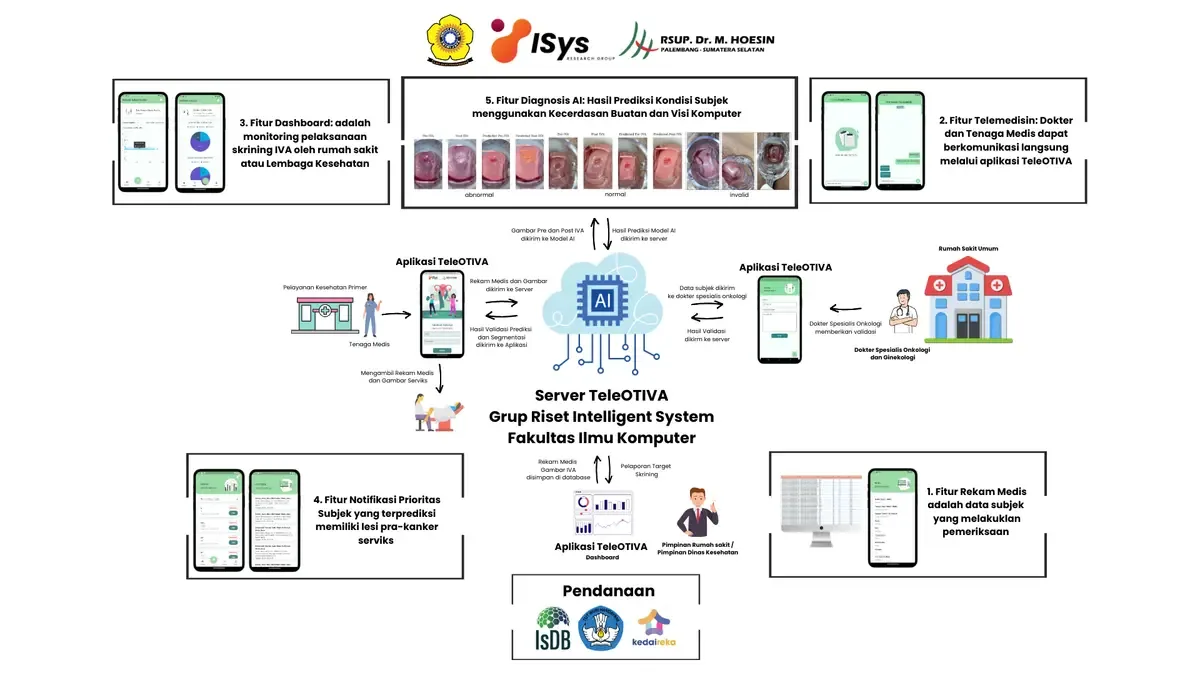
Figure 4. TeleOTIVA. Mobile, AI-assisted screening for precancerous cervical lesions from cervicography images — tested directly on 1,611 women aged 20–50 at Dr. Mohammad Hoesin Hospital Palembang and twelve primary health centres.
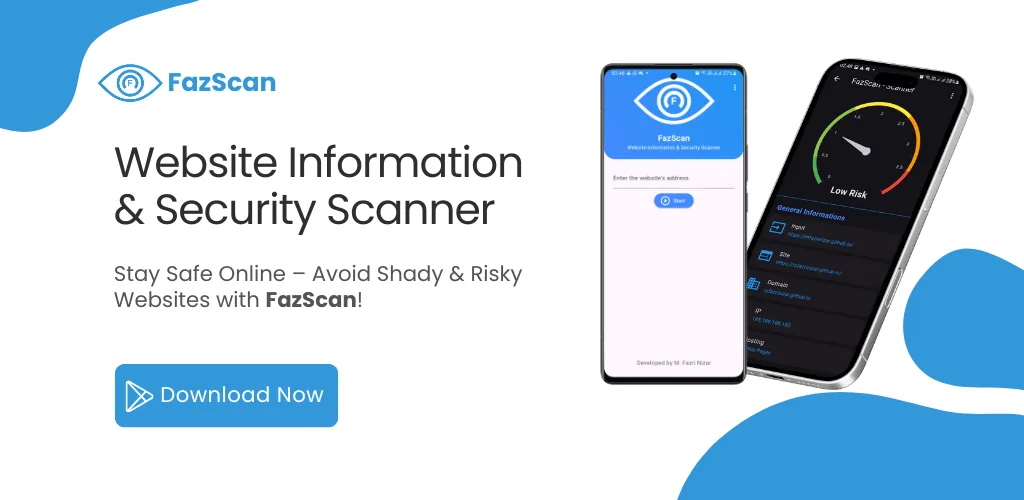
Figure 5. FazScan. A cross-platform website information and security scanner for Android, Windows and Linux, built with Flutter — developed as a research project for the Asia-Pacific Conference of Young Scientists 2022 in Computer Science.

Figure 6. Flutter Secure DotEnv. Encrypts environment keys for Flutter and Dart with AES, generated at build time — reliable key management and secret decryption so values in dotenv files stay confidential.
Figure 7. RF-DETR. Open-source contributor to RF-DETR, Roboflow’s real-time detection transformer for object detection and instance segmentation — seven merged pull requests, credited in releases 1.6.4 to 1.9.0.
Education
-
2023 2027
Bachelor of Computer Science, Informatics Engineering Universitas Sriwijaya
Indralaya, South Sumatra, Indonesia
Faculty of Computer Science. Beasiswa Unggulan 2024 awardee.
- Grade
- GPA 4.00 / 4.00
Aug 2023 – Apr 2027
Indralaya, South Sumatra, Indonesia
-
2020 2023
High School Diploma, Natural Sciences SMA Negeri 4 OKU
Ogan Komering Ulu, South Sumatra, Indonesia
Graduated with the highest score in the Natural Sciences major (eligible ranking).
- Core management (secretary), Rohani Islam (ROHIS)
- Member, English Debating Club
- Contributor, Scientific Research Paper Club
- Grade
- 94.36 / 100
Jul 2020 – May 2023
Ogan Komering Ulu, South Sumatra, Indonesia
Honors & Awards
-
Oct 2026
CVE-2026-96640 reporter, GitHub
Pillow (Python), versions 5.1.0 to 13.0.0:
PdfParser.linearize_page_tree()insrc/PIL/PdfParser.pytreats a PDF/Pagesgraph as a tree without tracking duplicate indirect references. WhenImage.save(..., format="PDF", append=True)processes an attacker-controlled existing PDF whose/Kidsarrays repeatedly reference the same child/Pagesnode, Pillow expands the shared subtree as distinct pages, so a compact malformed PDF can create exponentially many page references and consume disproportionate CPU before the append completes. Fixed in Pillow 13.0.0. -
Aug 2026
CVE-2026-15603 reporter, OpenJS Foundation
Credited for discovering and reporting unescaped Unicode line separators that allowed log forging in the Node.js
morganlogger. -
Oct 2024
International conference paper presenter, Ninth International Conference on Informatics and Computing (ICIC 2024), IEEE
Presented IDSpider [6].
-
Sep 2024
Awardee, Beasiswa Unggulan 2024, Ministry of Education, Culture, Research and Technology of the Republic of Indonesia
-
Aug 2024
Best Project, Mobile Development Technical Division, Google Developer Student Clubs Universitas Sriwijaya
-
Oct 2023
1st Place, Code League #8, Himpunan Mahasiswa Informatika Universitas Sriwijaya
-
Dec 2022
Special Prize Award in Computer Science, Asia-Pacific Conference of Young Scientists 2022, Fo Guang University, Asia Pacific Youth Exchange Development Association and New Taipei City (Taiwan), Sakha Junior Science Academy (Russia) and Center for Young Scientists (Indonesia)
For FazScan.
-
Nov 2021
1st Special Award in Computer Science, National Young Scientists Competition, Center for Young Scientists
For FazScan.
-
Oct 2021
1st Winner (Gold Medal) in Computer Science, South Sumatra Province Young Scientists Competition, Education Department of South Sumatra Province and Center for Young Scientists
-
Nov 2020
Best Subject (NormanAbramson) in Information Technology, Brainly Indonesia
-
Oct 2020
Best Moderator, Brainly Indonesia
Talks
-
Oct 2024
IDSpider: Indonesian Standard Dataset for Text-to-SQL, Ninth International Conference on Informatics and Computing (ICIC 2024), Medan, Indonesia
talk
-
Jan 2024
Hands On Study Jams: Case Studies for Enhancing Your Mobile Development and Machine Learning Skill, Mobile Development Study Jams 2024, GDSC Universitas Sriwijaya
workshop
Leadership & Service
-
2025 now
Member, Research, Innovation and Public Policy Forum Awardee Beasiswa Unggulan
Feb 2025 – Present
-
2024 2025
Core Team, Mobile Development Division Google Developer Group on Campus: Universitas Sriwijaya
- Organised events with the other core teams and ran open recruitment
- Assembled the division’s mobile-development curriculum to industry standards — 95%+ more engagement (by commits)
- Mentored 10+ division members and 150+ internal members of GDGoC UNSRI
Nov 2024 – Dec 2025
-
2024
Vice Chief Committee, Programming Mentoring Program 2024 Himpunan Mahasiswa Informatika Universitas Sriwijaya
Co-led Java-fundamentals training for new Informatics Engineering students and organised Code League HMIF Mentoring 2024 as its final competition.
Sep 2024 – Nov 2024
-
2024
Person in Charge, Software Engineering Team, SRIFOTON 2024 Himpunan Mahasiswa Informatika Universitas Sriwijaya
Co-led the front-end and back-end developers of the SRIFOTON 2024 website and acted as its back-end developer.
May 2024 – Nov 2024
-
2024
Manager, Problem Crafter and Problem QA, Competitive Programming Contest — IF Fest 2024 Himpunan Mahasiswa Informatika Universitas Sriwijaya
Wrote and managed problem statements and 10–50 test cases per problem on HackerRank to Codeforces standards, for the online preliminary and offline final rounds.
Mar 2024 – May 2024
-
2024
Staff, Academic Department — IT Development Division Himpunan Mahasiswa Informatika Universitas Sriwijaya
Back-end developer of the HMIF website development team 2024.
Feb 2024 – Dec 2024
-
2023 2024
Member, Mobile Development Division Google Developer Student Clubs Universitas Sriwijaya
Built projects for the GDSC Indonesia HackFest 2024 and the Google Solution Challenge 2024; best project of the mobile development division; speaker at Study Jams.
Nov 2023 – Oct 2024
-
2020
Lead in Information Technology Subject (NormanAbramson) Brainly Indonesia
Led the Information Technology subject with 318+ quality answers on data structures and algorithms, discrete structures and UML.
Nov 2020 – Dec 2020
-
2020 2021
Moderator Brainly Indonesia
Moderated 10,000+ pieces of content against Brainly Indonesia’s standards, working with other moderators on unusual cases.
Sep 2020 – Jan 2021
Certifications
-
Jul 2024
Go (Intermediate), HackerRank
ID 0F2270314D85
-
Jul 2024
Problem Solving (Intermediate), HackerRank
ID 0E538F8D8D6C
-
Jul 2024
REST API (Intermediate), HackerRank
ID 98525E8DABC7
-
Jul 2024
Software Engineer, HackerRank
ID FC0E31ECF4A7
-
Jul 2024
Software Engineer Intern, HackerRank
ID 13A320AD91E5
-
Jul 2024
SQL (Advanced), HackerRank
ID 8064F40F6B3C
-
Verified Google Play Developer, Google Play
-
Problem Solving (Basic), HackerRank
-
Python (Basic), HackerRank
Toolchain
| Group | Tools & techniques |
|---|---|
| Machine learning |
|
| LLM systems |
|
| Research practice |
|
| Mobile |
|
| Back end & DevOps |
|
| Security & cryptography |
|
| Programming languages |
|
| Spoken languages |
|
Correspondence
For research collaborations, engineering roles, or questions about a paper, write me a letter — it goes straight to my inbox. I read everything and usually reply within a few days.
Thank you — your letter is on its way. I usually reply within a few days.